University of DhakaDepartment of Robotics & Mechatronics Engineering

Research

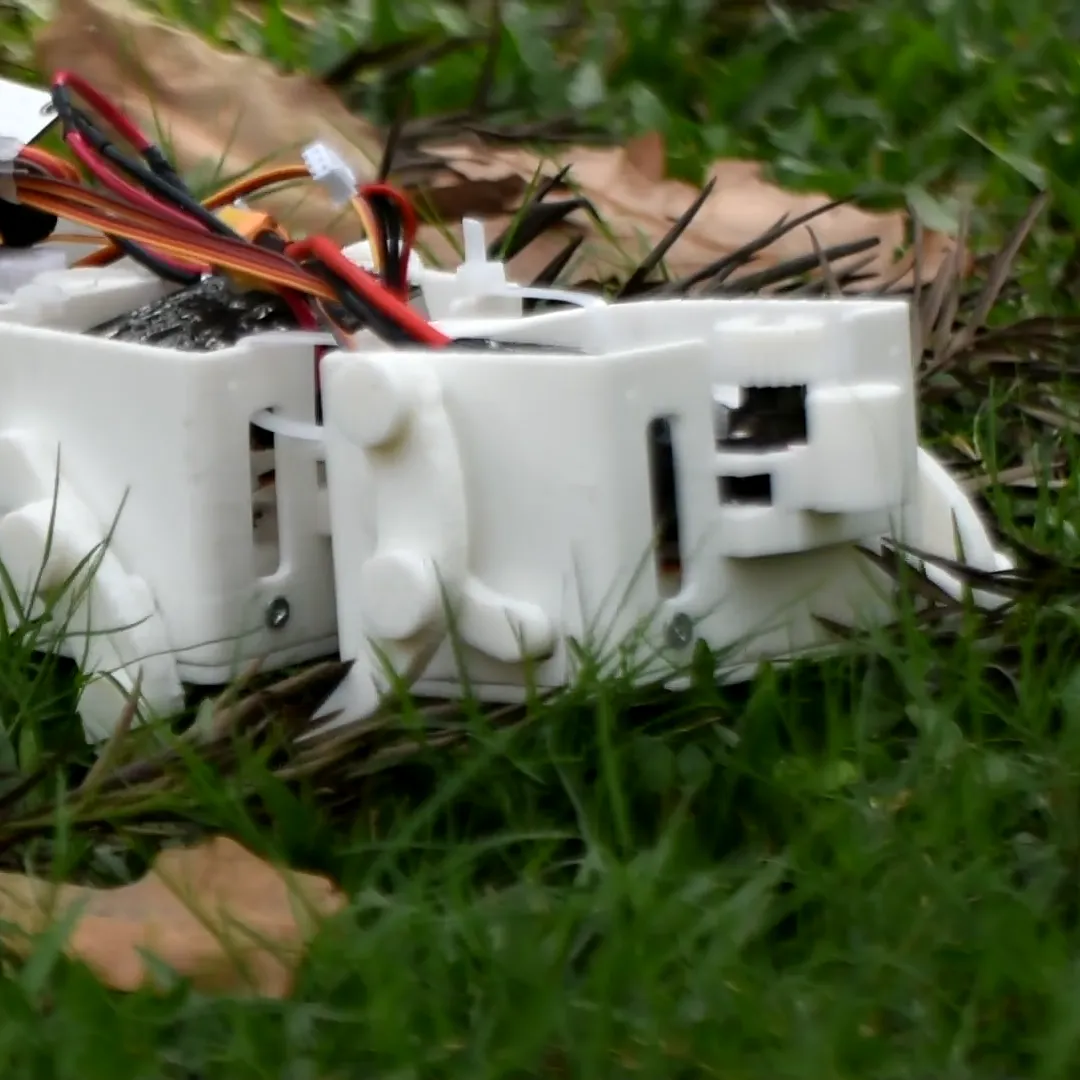
Flexipede: A Bio-Inspired, Modular Myriapod Robot for Rough-Terrain Traversal

Flexipede: A Bio-Inspired, Modular Myriapod Robot for Rough-Terrain Traversal

Samudra Jit Saha, Dr. Abhishek Kumar Ghosh, Md. Abid Chowdhury, Sayma Islam

The Flexipede/Decipede is a bio-inspired, modular myriapod robot designed for scalable and resilient traversal across rough terrains, targeting demanding applications like search-and-rescue and planetary exploration. To overcome the control complexity, weight, and high costs typically associated with existing multipedal robots, Flexipede utilizes a highly efficient single-actuator bipedal mechanism per module, enabling the easy addition or removal of individual segments. Adjacent modules are linked via custom active-yaw connectors for coordinated steering and maneuverability. Built with 3D-printable parts and off-the-shelf components, the system is highly cost-effective, costing approximately $58 for the initial primary module and $10 for each additional unit. Researchers tested configurations ranging from one to six modules, ultimately identifying the four-module setup as optimal for reliably navigating diverse, non-level environments. The robot demonstrated robust locomotive performance, achieving peak speeds of 9.14 cm/s on flat terrain and successfully clearing obstacles up to 32 mm high. Furthermore, it maintained impressive energy efficiency for its scale, recording an average Cost of Transport (CoT) of 17.91 on rough terrain. Ultimately, Flexipede provides a highly adaptable, low-cost platform that relies on mechanical intelligence to navigate irregular geometries without requiring complex active sensing or coordination strategies.
A Multimodal Wearable Headband for Eye Blink and Head Movement Gesture Recognition

A Multimodal Wearable Headband for Eye Blink and Head Movement Gesture Recognition

Shahriyar Maraz, Shahriyar Maraz

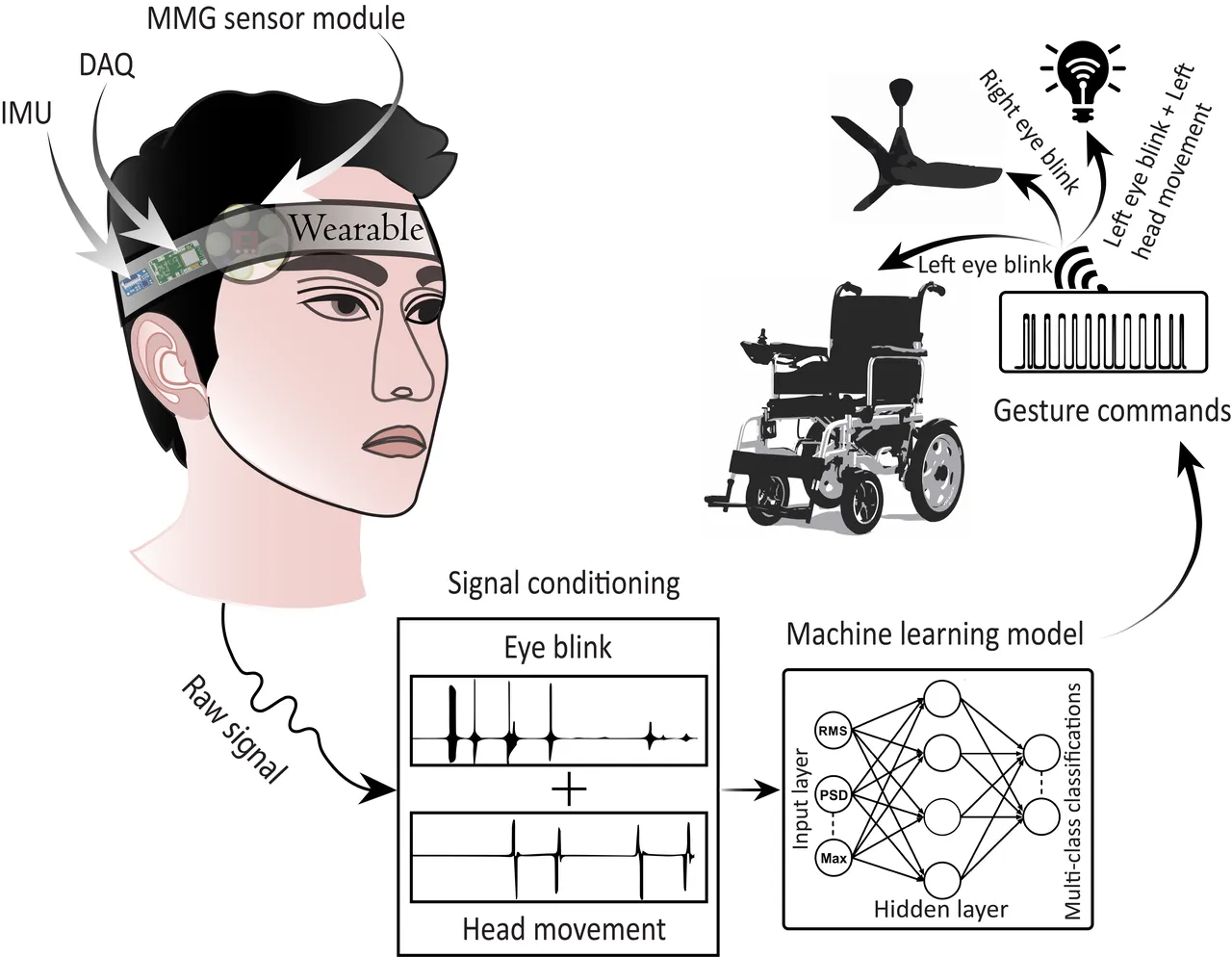
For individuals with severe neuromuscular conditions such as ALS or Locked-In Syndrome, voluntary eye movements often serve as the final means of communication. Existing eye-blink detection systems based on electrooculography and computer vision, however, remain limited in portability, robustness, and user comfort. To overcome these issues, we introduce a non-invasive, multimodal wearable headband that uses mechanomyography (MMG) and inertial sensing to recognize hybrid eye-blink and head-movement gestures. The headband integrates a custom MMG sensor module, an inertial measurement unit, and an embedded data acquisition system. MMG signal fidelity is enhanced through an empirically tuned analog front end and a custom EVA polymer membrane at the sensor–skin interface, improving mechanical coupling and increasing mean SNR from 10.04 ± 5.78 dB to 26.85 ± 6.51 dB (p < 0.0001). Data from 15 participants performing 14 ocular–cephalic gestures were used to train several classifiers. A neural network achieved the best performance, with 93.1% ± 1.6% participant-dependent accuracy and 87.0% ± 5.0% participant-independent accuracy. By reliably recognizing 14 gestures, the system significantly expands the command space of wearable assistive interfaces and provides a robust platform for real-world eye-blink and head-movement–based communication.

Mapping of Mechanomyographic Signals from Arm Muscle Compartments

Mapping of Mechanomyographic Signals from Arm Muscle Compartments

Saadman Sakib, Maliha Taslima Chowdhury

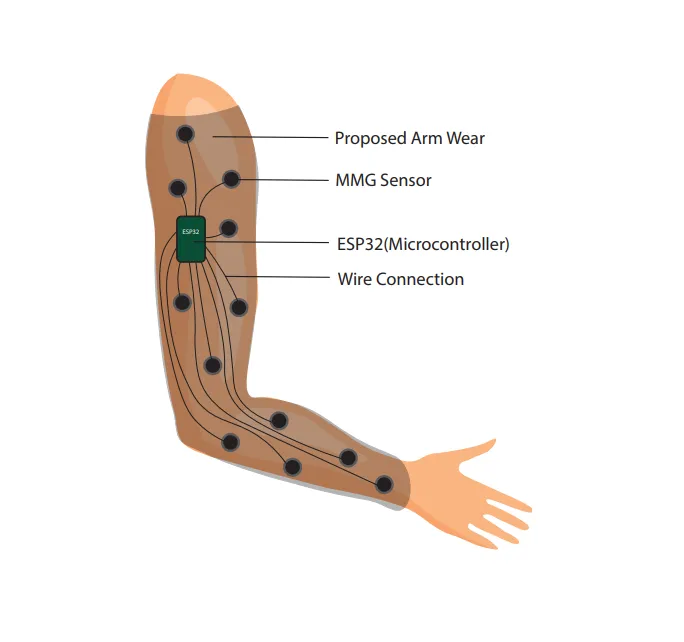
The study aims to detect a relationship between the muscle compartments and their response to the signals. We will map the MMG response of the muscle compartments of the arm and forearm. For some particular gestures, we will evaluate the responses from different muscle compartments, and find out the statistical correlation between gestures and signal responses. We will analyze the correlation between the muscle structure of individual people and their MMG signal response. This research will play a pivotal role in advancing the field of medical monitoring. This research is being conducted by Saadman Sakib and Maliha Taslima Chowdhury.

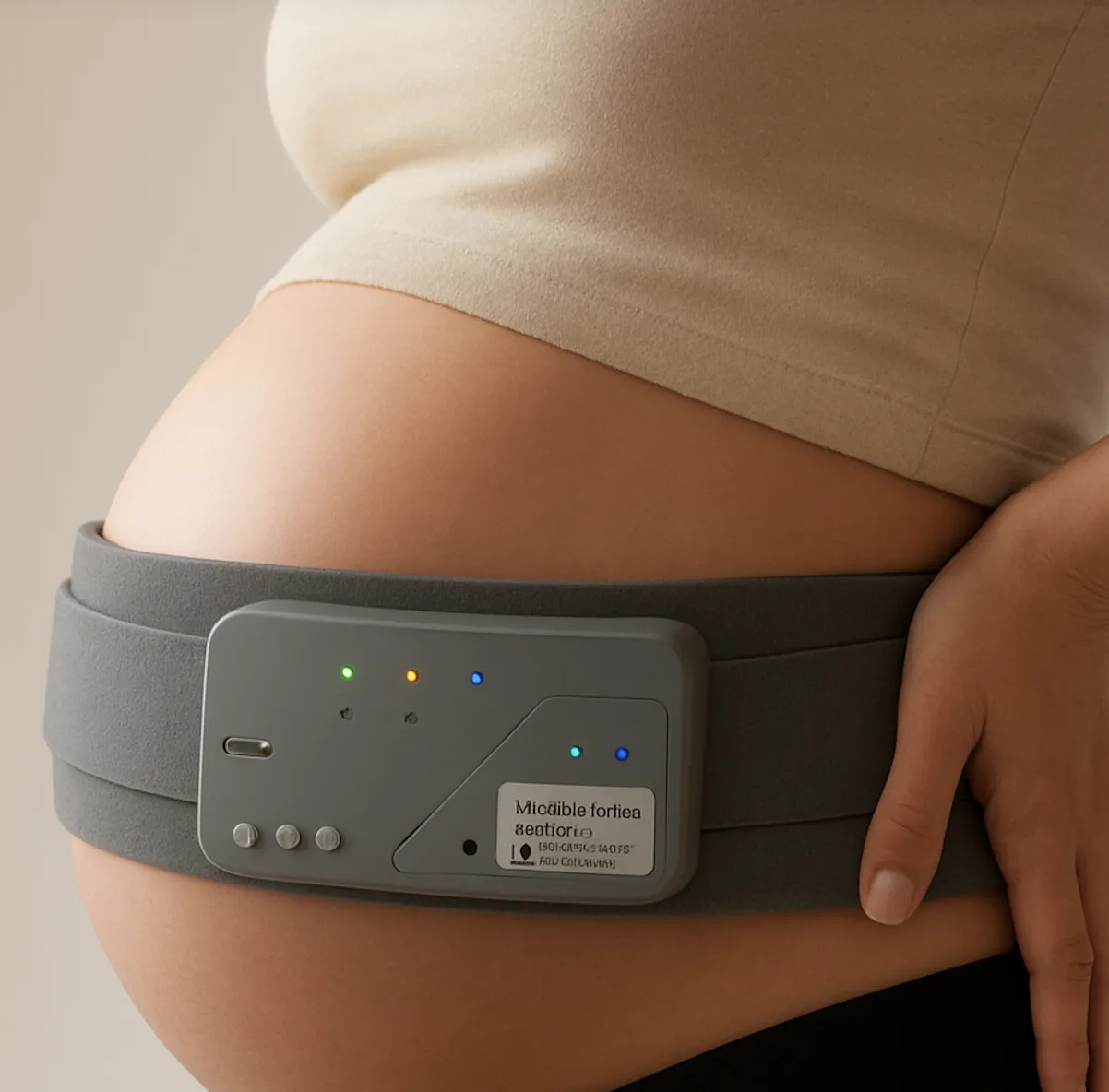
Translation of a Wearable Fetal Movement Monitor towards Stillbirth Prevention

Translation of a Wearable Fetal Movement Monitor towards Stillbirth Prevention

Dr. Abhishek Kumar Ghosh

Collaborative research between University of Dhaka and University College Dublin funded by Wellcome Leap InUtero